
In Texas's Most Competitive Districts, Democrats Now Lead Where Trump Won Big
During the summer of 2025, the Texas Legislature redrew the boundaries of the state’s 38 congressional districts with the goal of boosting the number of Republican victories in the 2026 midterm elections. This new map targeted five districts that were won by Democratic candidates in the 2024 election, dramatically reshaping the boundaries of three (TX-9, TX-32, TX-35), to such an extent that the Democratic incumbents in these districts (Congressman Al Green, Congresswoman Julie Johnson and Congressman Greg Casar, respectively), opted to compete for the Democratic nomination in other congressional districts (Casar successfully, and Green and Johnson unsuccessfully).
In contrast to the case of the three aforementioned districts, in the two other Democratic held districts that were targeted (TX-28 and TX-34), the Republican mapmakers left a substantial proportion of the current (2021 map) district population unchanged, but, did modify the district’s boundaries with the goal of making the partisan balance of the population more favorable for Republican candidates. Finally, while TX-15 (represented by Republican Congresswoman Monica De La Cruz) was not a targeted district, it was the one GOP held district whose boundaries were altered in such a way that it weakened the ability of Republicans to retain the seat more than was the case with any of the other 25 Republican controlled districts. While the partisan balance of TX-15 did not change notably as a result of the redistricting process, De La Cruz found herself having to compete in a district where only two-fifths of her current constituents presently live.

In a Divided Texas, Voters Agree on One Thing: Teach the Constitution
94% of Texas likely voters believe it is very important to teach Texas K-12 students about the U.S.
Constitution, while 5% believe it is somewhat important, 1% not too important, and 0% not at all
important.
86% of Texas likely voters believe that the State of Texas should spend more money on civics
education in Texas K-12 schools, while 3% believe it should spend less and 11% are of the opinion
that Texas is presently spending the right amount.
60% of Texas likely voters report that they were taught either a great deal (25%) or quite a bit
(35%) about the U.S. Constitution during their own K-12 education experience, while 28% report
they were taught some, 8% very little and 2% nothing at all about the U.S. Constitution when
they attended K-12 school, with 2% unable to remember.

Black Texas Voters Say Race Cost Crockett the Primary —and the Party Takes Them for Granted
The March 2026 Texas Democratic Party primary set a record for Texas Democratic primary turnout in a non-presidential election year, driven by the marquee U.S. Senate race between Congresswoman Jasmine Crockett and Texas State Representative James Talarico. Talarico (who is White) defeated Crockett (who is Black) by 6.3 percentage points (52.5% to 46.2%), with Ahmad Hassan garnering 1.3% of the vote. In all, 2.3 million Texans turned out to vote in the election.
In the survey, these Black Texas voters were asked: “How important, if at all, do you think Jasmine Crockett’s race was in influencing non-Black Democratic primary voters’ decisions not to vote for her in the March 2026 Democratic Texas U.S. Senate primary?” The response options were very important, somewhat important, not very important, not at all important, and don’t know. In the analysis below the 13% of the respondents who answered “don’t know” are excluded.

Senate Race A Toss-Up, With Narrow GOP Leads in Other Races
favorably by 39% of likely voters and unfavorably by 57%. Only 7% and 4% of likely voters don’t
know enough about Talarico and Paxton to have an opinion of them, respectively.
In the Texas Gubernatorial election, Republican Greg Abbott (49%) leads Democrat Gina Hinojosa
(43%) by 6 percentage points, with 3% supporting Libertarian Pat Dixon and 5% undecided.
Abbott is viewed favorably by 48% of likely voters and unfavorably by 51%, and Hinojosa is
viewed favorably by 37% and unfavorably by 28%. While 99% of likely voters know enough about
Abbott to have an opinion of him, only 65% know about Hinojosa to have an opinion of her.

Texas Voters Give Local Schools Higher Marks Than the State Overall, New TSU Survey Finds
More than half (56%) of these Texas registered voters rate the quality of K-12 public education in their local ISD as either excellent (15%) or good (41%), compared to the slightly less than half (48%) of these same registered voters who rate the quality of K-12 public education in Texas as either excellent (10%) or good (38%). More than two-fifths (43%) of these registered voters think the quality of public education in Texas is either only fair (31%) or poor (12%), compared to the less than one-third (31%) who think the quality of K-12 public education in their local ISD is either only fair (22%) or poor (9%).

Texas Voters Split on Election Integrity vs. Ballot Access, New TSU Survey Finds
24% of Texas registered voters believe there is a great deal of voter fraud in United States elections, 35% believe there is some voter fraud, 30% believe there is very little voter fraud, and 11% believe there is no voter fraud in U.S. elections.
While 83% of Texas Republicans believe there is either a great deal (36%) or some (47%) voter fraud in U.S. elections, only 30% of Texas Democrats believe there is either a great deal (11%) or some (19%) voter fraud.
While 70% of Texas Democrats believe there is either very little (50%) or no (20%) voter fraud in U.S. elections, only 17% of Texas Republicans believe there is either very little (12%) or no (5%) voter fraud.
50% of Texas registered voters believe that stopping voter fraud and illegal immigrants from voting should take priority over ensuring that eligible citizens are not denied the ability to vote.
50% of Texas registered voters believe that ensuring that eligible citizens are not denied the ability to vote should take priority over stopping voter fraud and illegal immigrants from voting.
When forced to choose, 80% of Texas Republicans prioritize election integrity over ballot access. When forced to choose, 88% of Texas Democrats prioritize ballot access over election integrity. When forced to choose, Texas Independents are evenly divided between those who prioritize ballot access (52%) and those who prioritize election integrity (48%).

New Poll: Texans Strongly Support Civics Education—But Say Schools Could Do More
79% of Texas registered voters believe it is very important for Texas students to have a basic understanding of the Declaration of Independence, of the U.S. Constitution and of the responsibilities of citizenship by the time they graduate from high school, with another 19% believing it is somewhat important, and 2% of the opinion that it is not very or not at all important.
78% of Texas registered voters believe that teaching about the country’s founding ideas such as individual liberty and a belief in equality is very important for America’s future, with another 20% believing it is somewhat important, and 2% of the opinion that it is not very or not at all important.
78% of Texas registered voters believe it is very important for Texas public schools to prepare students to be informed voters, with another 19% believing it is somewhat important, and 3% of the opinion that it is not very or not at all important.

New Poll: Texas 2026 Races Are Closer Than You Think
On May 26, U.S. Senator John Cornyn will face off against Texas Attorney General Ken Paxton in the Texas Republican primary runoff election, with the winner becoming the GOP standard bearer who will compete in the November 2026 Texas U.S. Senate election against Texas State Representative James Talarico, the Democratic Party nominee, and Ted Brown, the Libertarian Party nominee.
Talarico is viewed favorably by 46% of November 2026 Texas likely voters and unfavorably by 35%, with 19% of likely voters not knowing enough about him to have an opinion. Paxton is viewed favorably by 42% of these likely voters and unfavorably by 48%, with 10% of likely voters not knowing enough about him to have an opinion.
Cornyn is viewed favorably by 37% of these likely voters and unfavorably by 49%, with 14% not knowing enough about him to have an opinion. As a base of comparison, President Donald Trump is viewed favorably by 48% of these likely voters and unfavorably by 51%, with 1% having no opinion.

Redistricting and the 2026 Primaries: Houston Voter and District Analysis — Presentation Slides
This page provides public access to the complete presentation slides developed by the Barbara Jordan Policy Research & Survey Center at Texas Southern University and shared with Houston Endowment and regional partners on February 5, 2026. The presentation examines how recent redistricting changes are reshaping congressional and legislative districts across Houston and Harris County and what those changes mean for voters, candidates, and community engagement ahead of the 2026 election cycle.
Drawing on voter data, demographic trends, and district-level analysis, the briefing outlines where boundaries have shifted most significantly and identifies districts experiencing notable changes in voter composition and electoral competitiveness. Particular attention is given to historically Black and Latino districts, where redistricting intersects with longstanding patterns of representation and civic participation.
In addition to explaining the redistricting process and key legal and political developments, the presentation provides an overview of upcoming primary elections, competitive races, and voter education priorities designed to help residents better understand new district boundaries and their implications. As part of the Center’s public education initiative, these slides are shared as an open resource to support informed civic participation, community dialogue, and data-driven understanding of Houston’s evolving political landscape.
Texas Redistricting and the 2026 Primaries: What Changed and Why It Matters for Houston
This report examines the U.S. House map created by the State of Texas during the mid-decade redistricting process in the summer of 2025. First, it provides a brief background of legislative and legal developments in the area of redistricting which took place in 2025. Second, it examines the change and continuity in the population represented by each of the state’s 38 U.S. House districts under the old (2021) and new (2025) maps, with a particular focus on changes which dramatically altered the boundaries of three Houston area districts. Third, it explores the partisan lean of each one of the 38 congressional districts, with a particular focus on the 10 Houston area congressional
districts. Fourth, it examines the ethnic/racial distribution of the Citizen Voting Age Population (CVAP) of each one the 38 districts, with a more detailed focus on the 10 Houston area districts, including extended analysis of the region’s three most ethnically/racially diverse congressional districts. Fifth, given the pivotal role played by party primaries in determining the de facto winner in more than four-fifths of the state’s congressional districts, the report examines voter turnout in the state’s two most recent Democratic and Republican primaries (2022 and 2024), with a particular focus on turnout in the 10 Houston area congressional districts. Finally, the report provides a spotlight on the likely ethnic/racial, gender and age composition of the Democratic Primary electorate in three Houston area districts where a high level of competition is expected in the 2026 Democratic Primary elections and of the Republican Primary electorate in three Houston area districts where a high level of competition is expected in the 2026 Republican Primary elections.

Early Voter Sentiment in the 2026 Texas Democratic Primaries: Governor and Attorney General Races
This survey examines early vote preferences and candidate familiarity in the 2026 Texas Democratic primaries for Governor and Attorney General. Results reveal that a majority of likely primary voters remain undecided, underscoring the importance of voter engagement and name recognition in the months ahead. The findings offer insight into how demographic patterns may influence the trajectory of both races.
Shaping the Path to March 2026: Voter Preferences, Familiarity, and Turnout Dynamics in the Texas Democratic U.S. Senate Primary
This survey provides an early snapshot of voter sentiment in the 2026 Texas Democratic U.S. Senate primary, revealing clear demographic patterns in candidate support and familiarity. The findings underscore the distinct strengths voters associate with each candidate, particularly around turnout mobilization and crossover appeal. Together, the results offer insight into the dynamics shaping the Democratic primary electorate.
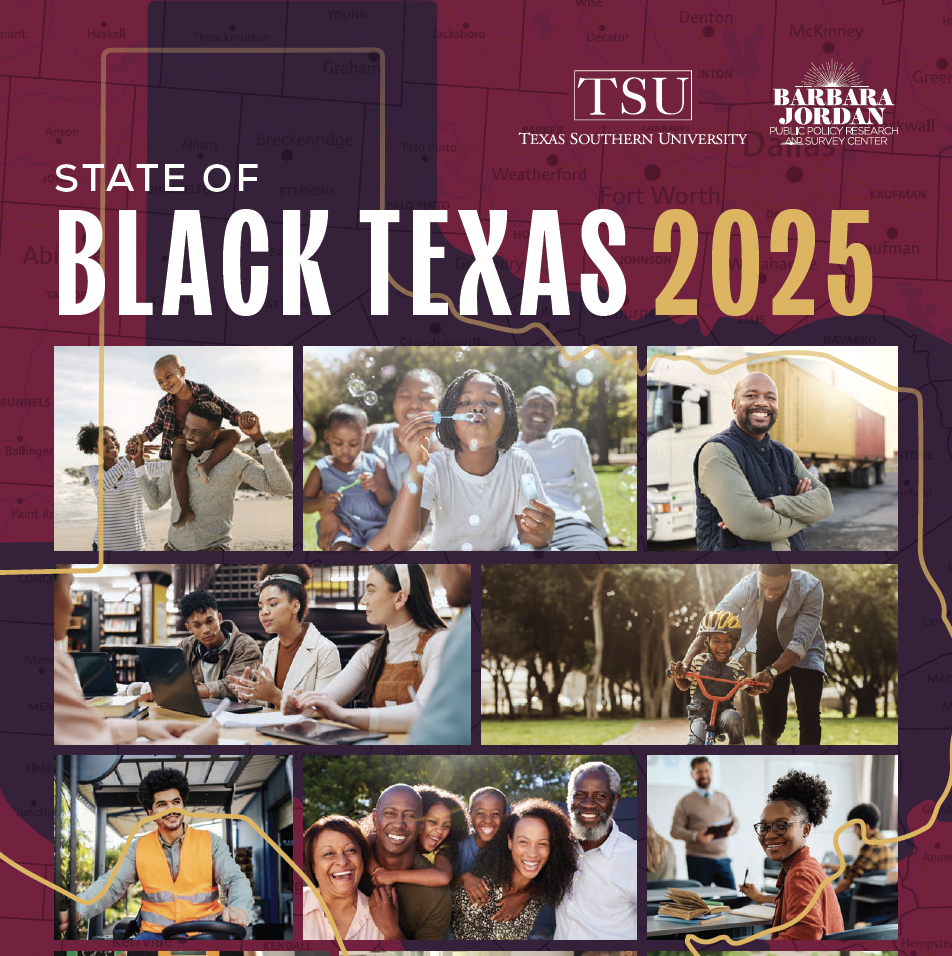
Black Texans and the Future of Education: Insights from the 2025 Report
Across five centuries, African Americans have shaped Texas’s political, economic, and cultural identity—persisting through slavery, segregation, and discrimination while building thriving communities, founding institutions, and expanding civil rights. Today, Black Texans remain central to the state’s progress, from legislative leadership to educational and civic life.

Texas Parents & Texas Education Freedom Accounts: Familiarity and Likelihood of Applying in 2026
The Barbara Jordan Public Policy Research and Survey Center surveyed 900 Texas parents in late October and early November 2025 to assess their awareness of the new Texas Education Freedom Accounts (TEFA) program and their likelihood of applying when it opens in 2026. Findings show parents are evenly split in their familiarity with TEFA, with higher-income and White parents reporting greater awareness. After learning about the program, a majority of parents—especially Black and Latino parents support the Legislature’s decision to create TEFA. Interest in applying is strongest among lower-income families and parents seeking better educational options or schools that meet their children’s needs. Parents satisfied with their current public schools or concerned about tuition costs expressed lower interest in applying. These results offer an early look at how Texas families view the state’s new school choice program. View the full report to explore the findings in detail.

Policy Preferences of Texas Primary Voters: Abortion, Marijuana, Guns, Immigration & Transgender Sports
The Barbara Jordan Public Policy Research and Survey Center at Texas Southern University surveyed 3,000 likely Republican and Democratic primary voters across Texas in August 2025. The results reveal a competitive and polarized landscape heading into the 2026 U.S. Senate primaries. On the Republican side, Attorney General Ken Paxton holds a slight edge over Senator John Cornyn, while former Congressman Beto O’Rourke commands a strong lead over Congressman Colin Allred among Democrats. The findings also highlight sharp divides along lines of religion, education, region, and demographics, as well as the continuing influence of endorsements from national political figures.

The 2026 Down-Ballot Texas Republican & Democratic Primaries: Attorney General, Comptroller & Agriculture Commissioner
The Barbara Jordan Public Policy Research and Survey Center at Texas Southern University surveyed 3,000 likely Republican and Democratic primary voters across Texas in August 2025. The results reveal a competitive and polarized landscape heading into the 2026 U.S. Senate primaries. On the Republican side, Attorney General Ken Paxton holds a slight edge over Senator John Cornyn, while former Congressman Beto O’Rourke commands a strong lead over Congressman Colin Allred among Democrats. The findings also highlight sharp divides along lines of religion, education, region, and demographics, as well as the continuing influence of endorsements from national political figures.
Texas 2026 Senate Primaries: Paxton and O’Rourke Lead Early Contests, But Divisions Run Deep
The Barbara Jordan Public Policy Research and Survey Center at Texas Southern University surveyed 3,000 likely Republican and Democratic primary voters across Texas in August 2025. The results reveal a competitive and polarized landscape heading into the 2026 U.S. Senate primaries. On the Republican side, Attorney General Ken Paxton holds a slight edge over Senator John Cornyn, while former Congressman Beto O’Rourke commands a strong lead over Congressman Colin Allred among Democrats. The findings also highlight sharp divides along lines of religion, education, region, and demographics, as well as the continuing influence of endorsements from national political figures.
Public Perception of Crime, Sentencing, Immigration Enforcement, and Bail Reform in Harris County
This report analyzes public opinion in Harris County on crime, sentencing, immigration enforcement, and bail reform based on a survey of 1,600 registered voters. The findings reveal how views vary across racial, income, and political lines. The data offers timely insight into community concerns and policy priorities at the local level.

Juneteenth, Texas, and the Long Arc of Black Political Power
A groundbreaking public opinion survey and historical analysis from the Barbara Jordan Public Policy Research and Survey Center explores Texans’ views on Juneteenth, the legacy of slavery, and the untold stories of Black legislators who shaped the state's future—from Reconstruction through today.